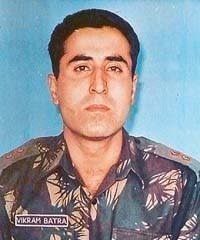
Vikram Batra PVC (9 September 1974 – 7 July 1999) was an Indian Army officer. He was posthumously awarded the Param Vir Chakra, the highest Indian military decoration, for his actions during the Kargil War; on 7 July 1999, Batra was killed while fighting Pakistani troops around Area Ledge, Point 4875, in the Kargil district of erstwhile Jammu and Kashmir.
Batra joined the Indian Military Academy (IMA) at Dehradun, in June 1996 in the Manekshaw Battalion. After completing his 19-month training course, he graduated from the IMA on 6 December 1997 and was commissioned as a lieutenant into the Indian Army. He was commissioned into the 13th battalion of the Jammu and Kashmir Rifles (13 JAK Rif). After commissioning, he was sent to Jabalpur, Madhya Pradesh for regimental training. The training lasted one month, from December 1997 to the end of January 1998. Beginning his service as a lieutenant, he rose to the rank of Captain.
Batra's battalion, the 13 Jammu and Kashmir Rifles (13 JAK Rif), reached Dras on 6 June, was placed under the command of 56 Mountain Brigade, and was given orders to act as reserves to the 2nd battalion of the Rajputana Rifles (2 Raj Rif) during their attack on Tololing mountain. The 18th battalion of The Grenadiers (18 Grenadiers) first attacked Tololing on 22 May, but were unable to capture the peak. 18 Grenadiers made four attempts to capture Tololing, but could only succeed in securing the lower slopes, while suffering heavy casualties. Eventually, 2 Raj Rif was assigned the mission of capturing Tololing and they did so on 13 June 1999. After the capture of Tololing, 13 JAK Rif marched from Dras to Tololing, reaching their destination in 12 hours. Upon reaching, Alpha company of 13 JAK Rif took over Tololing and a portion of the Hump Complex from 18 Grenadiers.
Vikram Batra

Manoj Kumar Pandey
Captain Manoj Kumar Pandey, PVC (25 June 1975 – 3 July 1999) was an officer of the Indian Army who was posthumously awarded India's highest military honour, the Param Vir Chakra, for his audacious courage and leadership during the Kargil War in 1999. An officer of the first battalion, 11 Gorkha Rifles (1/11 GR), he sacrificed his life for the nation in battle on bunker hill edge of the Khalubar Hills in village Garkon Aryan Valley of Kargil.
In early May, the intrusion in the Kargil sector was reported. The 1/11 Gorkha Rifles battalion had finished a one-and-a-half year tenure in the Siachen Glacier and was on-the-move to its peace-time location in Pune. The battalion was asked to move to the Batalik sector in Kargil. It was among the first units to be inducted into this sector. The unit, commanded by Colonel Lalit Rai, was assigned responsibility of the Jubar, Kukarthaam and Khalubar areas and their battalion headquarters was in Yeldor.
Captain Anuj Nayyar, MVC (August 28, 1975 – July 7, 1999) was an Indian Army officer of 17 Jat who was posthumously awarded the Maha Vir Chakra, India's second highest gallantry award, for exemplary valour in combat during operations in the Kargil War in 1999.
In 1999, the Indian Army detected a massive infiltration by Pakistani military and paramilitary forces in the Kargil region of Jammu Kashmir. The army quickly mobilized its forces to drive out the Pakistani infiltrators from Indian territory. 17 Jat was one of the battalions deployed in the region. Nayyar's first major operation involved securing Pimple II, a peak within the Pimple Complex, on the western slopes of Point 4875, a strategic peak in the Mushkoh Valley.
Due to its strategic location, securing Point 4875 was a top priority for the Indian Army. The peak, which stood at 15,990 feet above sea level, had extremely steep slopes and capturing the peak without aerial support was considered near impossible. In a last-ditch attempt, C Coy, 17 Jat, of which Nayyar was the second-in-command, decided to secure the peak without waiting for any aerial support on 6 July.

Anuj Nayyar
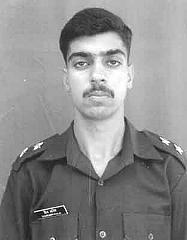
Saurabh Kalia
Saurabh Kalia (29 June 1976 – 9 June 1999) was an officer of the Indian Army who was killed during the Kargil War while being held as a prisoner of war by the Pakistan Army. He and five soldiers in his patrol group were captured by Pakistani troops following a gunfight at the Line of Control and allegedly tortured prior to their execution; the Government of Pakistan has rejected all allegations of Indian military personnel being tortured while in Pakistani custody.
Kalia was selected for the Indian Military Academy in August 1997 through the Combined Defence Services Examination and was commissioned on 12 December 1998. He was posted to the 4th battalion Jat Regiment in the Kargil Sector, where he arrived in mid-January 1999 after reporting at the Jat Regimental Centre, Bareilly, on 31 December 1998.
Indian officials claimed that Kalia and his men were held captive from May 15, 1999, to June 7, 1999, and were subjected to torture. They stated that the evidence of torture was apparent from the injuries on their bodies when they were handed over by the Pakistani Army on June 9, 1999. Post-mortem examinations conducted by India reported that the prisoners variously had cigarette burns, ear-drums pierced with hot rods, many broken teeth and bones, fractured skulls, eyes that had been punctured before being removed, cut lips, chipped noses, and amputated limbs and genitalia. According to the examinations, these injuries preceded the captives being shot dead in the head. However, The Guardian noted that there was no independent international observer at the post-mortem.
Captain Neikezhakuo Kengurüse, MVC (15 July 1974 – 28 June 1999) was an Indian Army officer from Nagaland. Kengurüse was an officer of 2 Rajputana Rifles, who was posthumously awarded the Maha Vir Chakra, India's second highest gallantry award, for his exemplary valour in combat during operations in the Kargil War in 1999.
Kengurüse passed the Combined Defence Services Examination in 1996 and joined the Indian Military Academy, Dehradun in Jun 1997 to fulfill his dream of serving the Indian army. Kengurüse was commissioned into the Army Service Corps of the Indian Army on 12 December 1998, and was in the midst of his field attachment with the 2nd Rajputana Rifles battalion. He was fondly nicknamed Neibu by his family and friends.[6] Some soldiers under his command called him Nimbu Sahib. A memorial was constructed at Pheza Village in his memory.
On 28 June 1999, at Lone Hill, Drass sector as the commander of Ghatak platoon, a commando platoon, Kenguruse was assigned the task to evict Pakistani soldiers holding a machine gun post at Black Rock, Dras Sector and to capture the area. Kengurüse established foothold for his platoon at 16000 feet. Capt. Kengurüse is one of the top 15 decorated soldiers and officers of Kargil War.
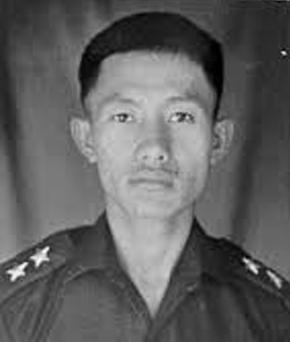
Neikezhakuo Kengurüse

If anyone has any queries or want me to update please contact me....
Name: Pratyusha Nandy
Email: pratyushanandy1@gmail.com
Ph.No: 7439697919