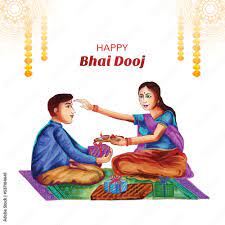
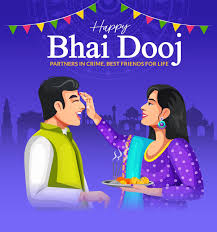
| "Bhai Dooj," also known as "Bhaiya Dooj" or "Bhai Tika," is a Hindu festival celebrated two days after Diwali, on the second lunar day of Shukla Paksha (bright fortnight) in the Hindu lunar calendar month of Kartika. This festival celebrates the bond between brothers and sisters.The festival's name translates to "Bhai" meaning brother and "Dooj" meaning the second day after the new moon, indicating that it falls on the second day after the new moon in the Hindu month of Kartika. It is similar to Raksha Bandhan, another popular festival celebrating the bond between siblings, but while Raksha Bandhan focuses on the sister's tying a protective thread or rakhi on her brother's wrist, Bhai Dooj emphasizes the brother's role in protecting and caring for his sister.On Bhai Dooj, sisters perform aarti (a ritual of worship involving light) for their brothers and apply a red tika (mark) on their foreheads, praying for their long life and prosperity. Brothers, in return, offer gifts and blessings to their sisters as a symbol of their love and commitment to protecting them. It is a day filled with joy, love, and familial bonding.. |
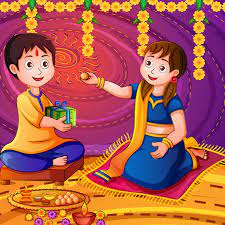 |
| On Bhai Dooj, sisters perform aarti (a ritual of worship involving light) for their brothers and apply a red tika (mark) on their foreheads, praying for their long life and prosperity. Brothers, in return, offer gifts and blessings to their sisters as a symbol of their love and commitment to protecting them. It is a day filled with joy, love, and familial bonding.Bhai Dooj holds cultural significance beyond its religious aspects. It strengthens the bond between siblings and reinforces the values of love, respect, and mutual care within families. The festival is celebrated with enthusiasm and fervor across India and in Hindu communities around the world, bringing families together to cherish and honor the special relationship between brothers and sisters. |