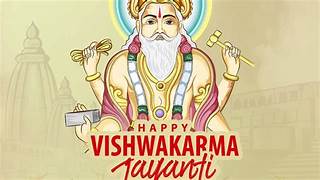
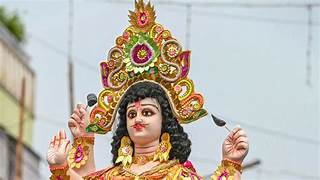
| The festival is observed primarily in factories and industrial areas, often on the shop floor. The day is marked by artisans, craftsmen, mechanics, smiths, welders, industrial workers, factory workers, engineers, architects, and other workers. Adherents pray for a better future, safe working conditions and, above all, success in their respective fields. Workers also pray for the smooth functioning of various machines. The workers associate their workmanship with the concept of shakti (power), and sometimes see themselves as the children of Vishvakarma.Shrines for the deity are constructed in parts of the workspace for the veneration of tools and machines associated with the line of work. Prasada is often distributed among the workers after offering veneration to the deity for his grace.
Image of Vishvakarma, Bengal
In many parts of India, there is a government holiday on 17 September for the occasion, but it is not considered as a national holiday but as a "restricted holiday", whereas in Nepal, there is a full government holiday on this day. |
 |
s